
Breakthrough Testing builds on Clutter Testing by also testing your video on its own, then comparing the two conditions. The comparison tells you whether your message is persuading and being held back by competing ads, or whether the message itself isn't landing. We produce a Breakthrough Score that quantifies the gap.
Key Details
- Cost: 2x the credits of a Video a standard video RMT (each message tested in two conditions)
- Test type: Standard RMT only
- Sample size: Doubled sample required for Tier 3 audiences and below
- Turnaround: Adds 1 day to standard RMT turnaround
- How to request: Contact your Client Success Manager or support@growprogres.ai
- Results delivery: Results in platform for both solo and cluttered conditions, plus a supplementary Breakthrough Score PDF report from your CSM
How It Works
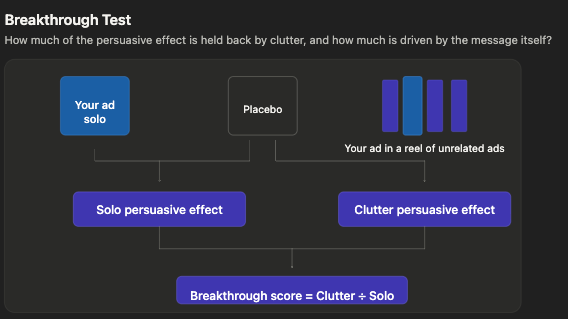
In an Breakthrough Test, your video is shown to respondents in two conditions:
- Solo, where your video is the only ad shown.
- In clutter, where your video is placed second in a four-ad reel of unrelated ads — this is what we call clutter.
Each condition is independently compared against the same placebo group, and we produce 3 different results:
- Solo persuasive effect
- Clutter persuasive effect
- Breakthrough Score: the ratio of the two — Clutter persuasive effect divided by Solo persuasive effect, expressed as a percentage from 0 to 100%.
A higher score means your message holds up well in clutter. A lower score means your creative depends on having the viewer's full attention.
Format matching
We match the clutter reel to the format of the video you provide. If you submit a vertical, social-friendly ad, we'll place it alongside other vertical ads in the reel. If you submit a traditional TV-format ad, we'll surround it with ads in the same format. This keeps the viewing environment consistent with where your creative will actually run.
When to Use Breakthrough Testing
Clutter Testing answers the question most clients have: does my message work in the environment where it'll run? Breakthrough Testing is for the smaller set of research questions that require a comparative diagnostic. Use it when you're:
- Diagnosing whether your message is persuasive in clutter, weakened by clutter, or not landing in either condition. The solo-vs-clutter comparison tells you whether to keep iterating on the same message (the persuasion is there; it just needs to break through clutter) or pivot to a new concept entirely.
- Comparing creative approaches to understand which formats break through best for your audience (e.g., testimonial-style ads vs. animated explainers).
- Building institutional knowledge about what holds attention in your category, to inform future production.
- Running a single test instead of separate solo and clutter rounds. If you'd otherwise pretest your video solo before running it in clutter, Breakthrough Testing combines both reads into one test.
If you're validating a single piece of finalist creative for a campaign, Video Breakthrough Testing is the more efficient choice and gives you the signal you need without the additional cost.
What You Get
Results for each message appear in the platform for both the solo and cluttered conditions, just like any other RMT.We will also share a supplementary Breakthrough Score PDF report that includes:
- Breakthrough Scores for each success question, so you can see how each message held up across the outcomes you measured (e.g., favorability, vote choice, issue support).
- Subgroup breakouts of Breakthrough Scores, so you can identify which audiences your creative breaks through with most effectively.
Here's a sample report if you want to view one.
What to Expect from Your Results
Persuasive effects tend to be smaller in the clutter condition. This is expected: in a cluttered environment, your ad has to win attention before it can persuade. Some viewers will be focused on what's around it, and a message that doesn't get attention can't move anyone. The Breakthrough Score is designed to make this comparison interpretable — it tells you how much of your persuasive effect survives when your message has to compete for attention.
A lower score doesn't mean your creative isn't working. It means the creative is more dependent on full attention than on hooks, pacing, or visual distinctiveness. That's a useful diagnostic for your next round of production.
Best Practices
- Test your strongest creative. Breakthrough Testing is most valuable for comparing finalists or learning from finished creative, not as a first-pass screen. Identify your top performers in a standard RMT first, then bring them into an Breakthrough Test.
- Use larger samples for sharper reads. Differences between solo and clutter conditions are often modest, so well-powered tests give you the cleanest signal.
- Build it into your testing plan from the start. Knowing you'll run an Breakthrough Test on finalists shapes how many concepts you screen in the initial round and how you sequence your research budget.
- Use pre and post-measurement questions. The performance gap between solo and clutter conditions can be small when the creative is breaking through well. Pre-post estimated treatment effects increase our ability to understand the exact magnitude of the difference between the two conditions.
How to Request an Breakthrough Test
Contact support@growprogress.ai or your Client Success Manager to set up a Breakthrough Test.